
1050nm Red Light Therapy: A Practical Evidence-Based Guide
Technical Guide · Near-Infrared Photobiomodulation
1050nm is a near-infrared wavelength increasingly included in multi-wavelength red light therapy systems. This guide explains what it is, where it may fit, how it compares with 660nm, 850nm and 940nm, and which specifications matter when evaluating a professional device.
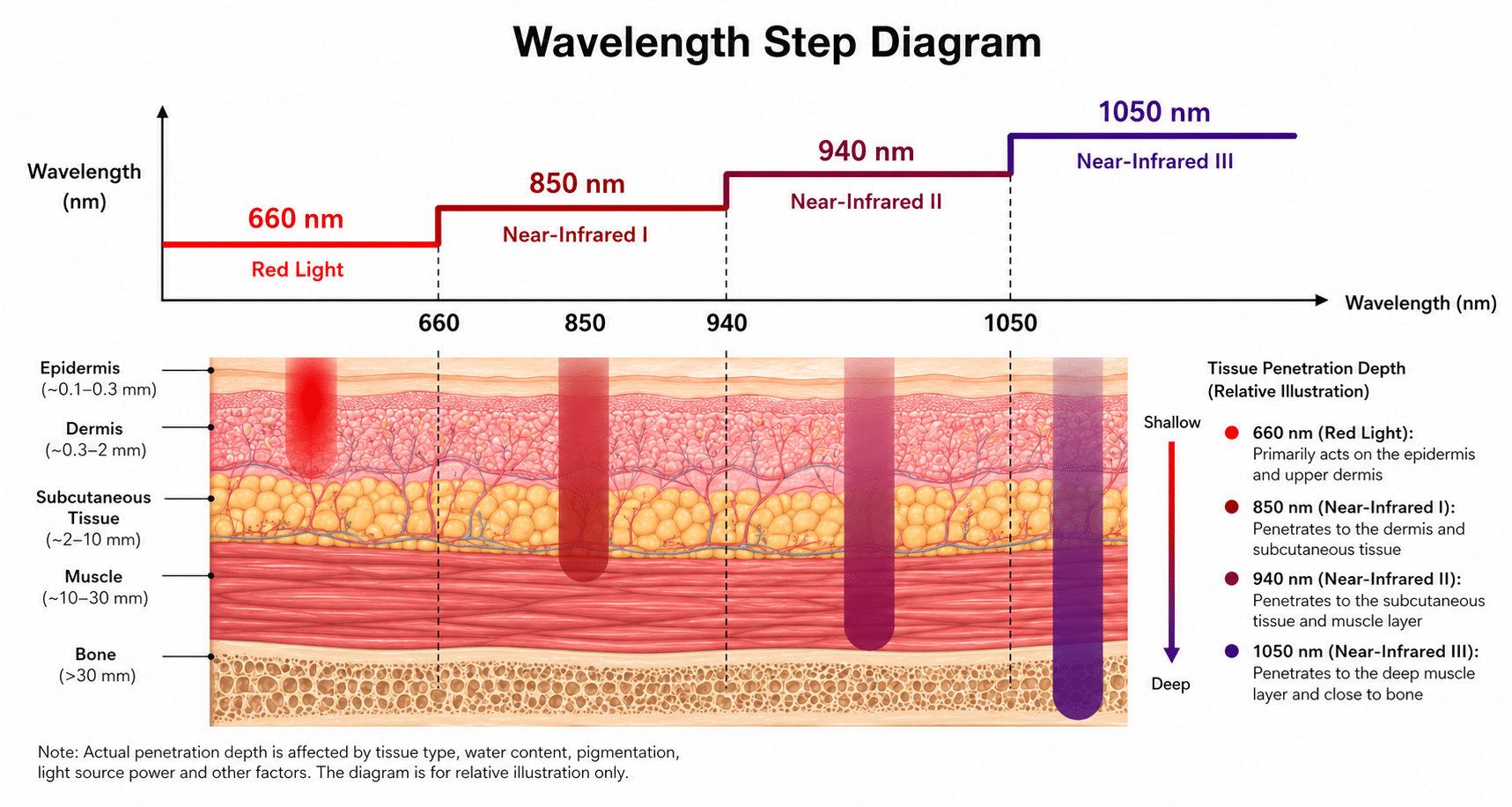
What Is 1050nm Red Light Therapy?
Red light therapy, also called photobiomodulation, uses non-ionizing red and near-infrared light to influence biological processes. A wavelength of 1050 nanometers sits beyond visible red light in the near-infrared range, so the human eye cannot see it even when the LEDs are operating.
Biological response depends on how much optical energy reaches the intended tissue and how that tissue absorbs and scatters the light. This is why a credible device evaluation must go beyond a wavelength list.
Wavelength
Describes the color or spectral position of light and influences absorption and scattering behavior.
Irradiance
Power delivered per unit area, commonly reported in mW/cm² at a stated distance.
Fluence
Total optical energy per unit area, commonly expressed in J/cm².
Geometry
LED spacing, optics, beam angle, panel size and distance affect uniformity and practical coverage.
660nm vs 850nm vs 940nm vs 1050nm
No single wavelength is automatically “best.” Multi-wavelength systems are designed to combine spectral ranges that may serve different surface and subsurface targets.
| Wavelength | Visible? | Common role in devices | Practical consideration |
|---|---|---|---|
| 660nm | Visible red | Surface-oriented applications and skin-facing protocols | Strong visual output does not mean higher therapeutic power. |
| 850nm | Near-infrared | Widely used for broader muscle and recovery protocols | Often forms the core NIR channel in professional panels. |
| 940nm | Near-infrared | Additional NIR coverage in multi-band systems | Water absorption and thermal behavior should be considered. |
| 1050nm | Near-infrared | Longer-wavelength extension for deeper-targeting system designs | Requires measured output and realistic dose planning. |
This table describes common design roles, not guaranteed clinical outcomes.
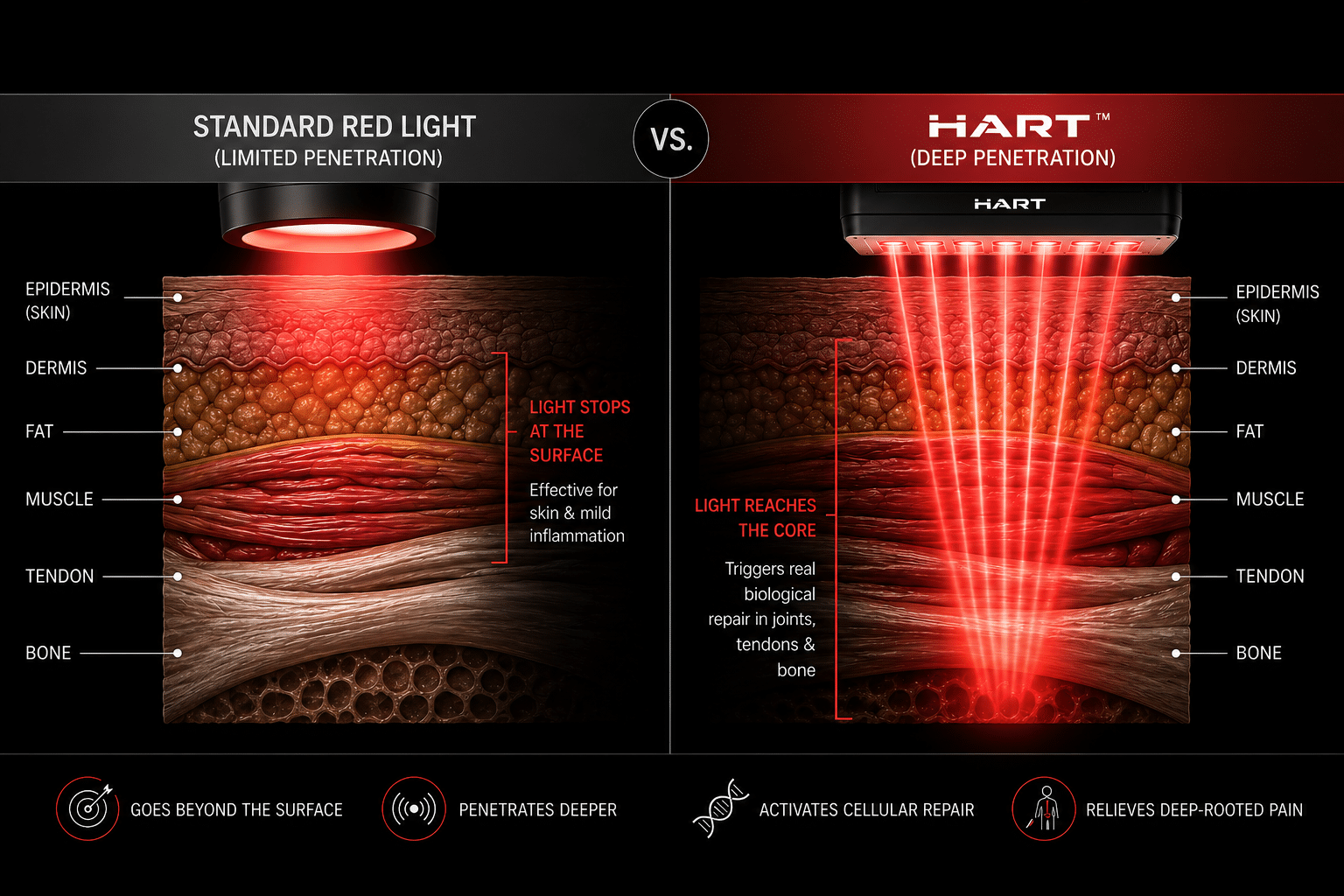
Why Add 1050nm to a Multi-Wavelength System?
Broader spectral strategy
A four-wavelength panel can distribute optical output across visible red and multiple near-infrared bands instead of relying on one wavelength for every target.
Protocol flexibility
Independent channel control can help clinics and product developers create repeatable protocols for different treatment distances, areas and session goals.
Engineering differentiation
For OEM projects, 1050nm can be part of a differentiated spectral configuration when supported by verified component specifications and optical testing.
Evidence-aware development
1050nm should be positioned as an engineering option within photobiomodulation, not as proof of a specific medical result.
Parameters That Matter More Than a Wavelength Label
| Parameter | What to request | Why it matters |
|---|---|---|
| Irradiance | mW/cm² measured at each stated distance | Determines the rate of energy delivery. |
| Fluence | J/cm² for the intended session | Connects irradiance with exposure time. |
| Spectral verification | Measured peak wavelength and tolerance for each channel | Confirms that installed LEDs match the stated design. |
| Uniformity | Measurement grid or optical map across the treatment area | Identifies hot spots and low-output zones. |
| Distance | All measurements tied to an exact distance | Output changes substantially as distance changes. |
| Thermal performance | Surface temperature and stability during a full session | Supports comfort, consistency and component life. |
| Controls | Independent wavelength channels, timer and dimming | Improves protocol repeatability. |
Professional Application Scenarios
Clinics and recovery centers
Large-area panels can support standardized sessions where staff document distance, duration, intensity and wavelength mode.
Sports and wellness facilities
Multi-wavelength systems may be considered for non-invasive recovery and wellness workflows, subject to local claims and device rules.
Research and protocol development
Independent channel control helps teams compare configurations while keeping dose and geometry documented.
OEM and private-label programs
Distributors can specify wavelength ratios, controls, enclosure, branding, packaging and compliance documentation for their market.
How to Evaluate a 1050nm Device Manufacturer
- Request test conditions. Every irradiance claim should include distance, meter type and measurement method.
- Verify the spectrum. Ask for spectral test data for 660nm, 850nm, 940nm and 1050nm channels.
- Review uniformity. A center-point reading alone does not describe full treatment-area performance.
- Confirm thermal management. Review heat-sink, airflow, fan noise and long-session stability.
- Check electrical and market documentation. Required reports vary by product class and destination market.
- Define claims before packaging. Product copy should remain consistent with available evidence and applicable regulations.
- Plan quality control. Agree on incoming LED inspection, burn-in testing, final optical checks and traceability.
Limitations and Responsible Use
- Research on photobiomodulation is heterogeneous: wavelength, dose, target tissue, device geometry and endpoints vary between studies.
- Longer wavelength does not guarantee that a clinically meaningful dose reaches a deep target.
- More power or a longer session is not automatically better; photobiomodulation can show dose-dependent responses.
- Eye protection, photosensitizing medication, pregnancy, active medical conditions and treatment near sensitive areas require appropriate professional guidance.
- This page provides technical and educational information and is not medical advice or a substitute for diagnosis or treatment.
Frequently Asked Questions
Is 1050nm the same as red light?
It belongs to the broader red-light-therapy category, but 1050nm itself is invisible near-infrared light rather than visible red light.
Does 1050nm penetrate deeper than 850nm?
Its optical behavior differs, but practical penetration depends on absorption, scattering, irradiance, geometry and tissue. A wavelength number alone cannot establish effective depth.
Can 1050nm be used alone?
It can be engineered as a dedicated channel, but professional systems often combine it with 660nm, 850nm and 940nm to broaden spectral coverage.
How long should a session last?
Session time must be calculated from measured irradiance and the intended fluence. A universal time recommendation is not technically responsible.
What should buyers ask an OEM supplier to provide?
Request spectral data, irradiance at stated distances, uniformity measurements, thermal testing, electrical documentation, quality-control procedures and warranty terms.
Is 1050nm proven to treat disease?
No wavelength should be presented as a universal disease treatment. Product claims must match the specific evidence, intended use and regulatory status.
Evidence and Further Reading
These peer-reviewed reviews provide useful background on photobiomodulation mechanisms, dosing and translational limitations:
- Mechanisms and applications of photobiomodulation
- Photobiomodulation and dose-related considerations
- Near-infrared light in biomedical research
- Clinical and translational considerations in photobiomodulation
- Optical and biological response considerations
References are supplied for scientific context. They do not validate every device configuration or commercial claim.
Develop a Multi-Wavelength System with HART Biotech
For clinic, distributor or OEM projects, HART Biotech can discuss wavelength configuration, optical targets, enclosure design, control functions, branding and production requirements.
Discuss Your Project